


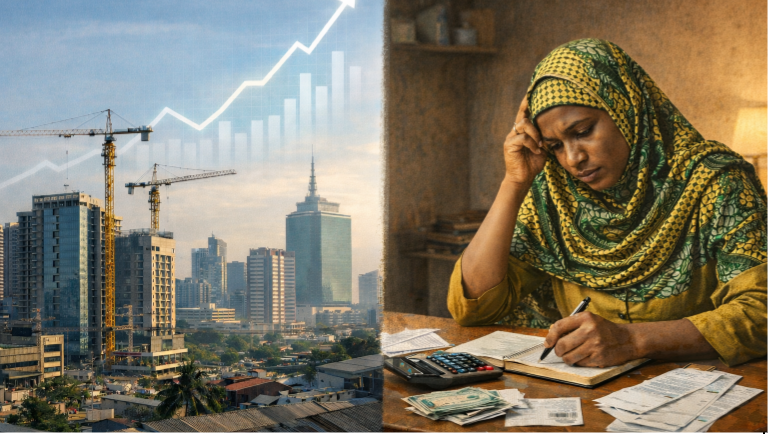
Each time new economic numbers are released, Nigerians respond with familiar scepticism. Government officials point to signs of recovery; citizens respond that their reality feels unchanged. In buses, markets, offices and group chats, the language is consistent: money feels tighter, profits thinner and planning harder. Both perspectives are correct; they simply describe different economies.
Nigeria has a national economy, and Nigerians have personal economies. At the moment, the national economy is stabilising while most personal economies remain under pressure. Recognising this distinction is the starting point for understanding why many households still struggle even as macroeconomic indicators improve.
Economic recovery begins at the level of production, fiscal balances and investment flows. Household recovery, however, is experienced through income stability, purchasing power, and the ability to absorb financial shocks. When significant policy adjustments occur, such as exchange rate reforms, subsidy removal, and fiscal consolidation, they are intended to correct structural distortions within the broader economy. Yet households often encounter the immediate effects through rising costs and tighter cash flow, while the anticipated gains unfold more gradually. This creates a transition period in which macroeconomic indicators may show improvement even as many citizens continue to experience financial strain. This explains why the relevant question for Nigerians today is not whether the economy is good or bad, but whether their personal financial systems are designed to withstand volatility. Many households are waiting for relief; yet, financial security rarely comes from relief. It comes from structure.
For most Nigerians, financial life runs on effort rather than systems. Income arrives, expenses compete, emergencies interrupt, savings are postponed, and the cycle repeats. Each year demands greater hustle with little change in long-term position. The constraint is not always income alone. It is decision fatigue. When every month requires deciding whether to save, invest or prepare for emergencies, immediate needs almost always win. School fees, family obligations, rent increases and urgent requests consistently defeat future planning. Financial stability, therefore, does not depend only on discipline. It depends on reducing the need for discipline.
There is a reason certain payments occur before salaries are received. Taxes are deducted at source, and pension contributions are removed automatically. This is not simply administrative convenience; it reflects a behavioural truth: people follow default settings. Recently, while helping a relative reactivate a pension account after nearly eight years outside formal employment, he assumed little remained in the account. Instead, the balance exceeded four million naira; most of it was investment growth rather than original contributions. He did not consciously save the money; the system saved it for him. The lesson here is that while many Nigerians intend to save, only a few have systems that make saving unavoidable.
Financial health is often equated with high income, yet across income levels, a similar pattern appears. Salary earners experience pay increases that vanish into rising living costs. Business owners see revenue rise while profit shrinks. Traders sell more, but restocking costs consume gains. The challenge is therefore not only earning more but building resistance to shocks. Financial health means the ability to absorb an unexpected expense without panic, to avoid borrowing in every crisis and to plan beyond the next month. Stability precedes prosperity.
This shift requires practical behavioural changes rather than complex financial knowledge. The first is saving before money is visible; automatic transfers on income day, even small ones, matter more than occasional large deposits. The second is establishing a modest buffer capable of covering one month’s expenses; this alone reduces poor financial decisions made under pressure. The third is separating spending functions: bills, daily use and savings, so that affordability becomes visible rather than assumed. The fourth is prioritising protection before high-return investment; insurance and emergency reserves prevent progress from being erased by setbacks. The fifth is automating preparation for predictable expenses such as rent, school fees or retirement, recognising that consistency is more powerful than intention.
Encouragingly, parts of Nigeria’s fintech ecosystem have begun responding to this behavioural reality. Several digital savings and payments platforms now allow users to divide income into purpose-driven “buckets”, separating rent, school fees, household expenses and long-term savings within a single interface. While more evidence is needed to assess how consistently these tools translate into improved financial outcomes, the design direction is important. It reflects a growing recognition that financial health is not only about access to money, but about structuring how money is used.
In earlier decades, survival depended largely on effort. In modern volatile economies, survival depends on design. Inflation cycles, currency adjustments and cost shocks will not disappear soon; economies move in cycles, and stability increasingly belongs to those who prepare structurally rather than react emotionally. The households that cope during economic shifts are rarely distinguished by income level but by preparation.
For years, Nigerians have asked when the economy will improve. A more useful question now is how individuals can build financial systems capable of withstanding change. National recovery takes time to reach households, but personal financial stability does not require waiting for macroeconomic perfection. While individuals cannot control inflation or exchange rates, they can control financial architecture, and in uncertain environments, structure consistently outperforms optimism.
Nigeria’s recovery is real, but recovery alone does not guarantee security. The next chapter of economic reform must move beyond stabilising markets to strengthening households. Financial stability cannot remain a private struggle; it must become a national priority, reflected in national policies, product design, workplace practices, and personal behaviour alike.
Nations ultimately grow from the resilience of their citizens. If households remain one shock away from crisis, recovery will feel fragile no matter how strong the statistics appear. But if families begin to build buffers, automate discipline and design their finances deliberately, then growth will finally become tangible.
In a recovering economy, stability is not automatic. It is built, intentionally, collectively and structurally.